For cybersecurity sales teams in Europe

CISOs don't pick up. Wrong numbers are why.

Your reps call security leaders on mobiles bought from the same providers as every other security vendor. Many are dead. Some reach the wrong person. Some are the CISO's private phone. Answrd checks every mobile before your team dials it.

Test 100 numbers freeNo card. Results in a few days.
ciso-list-q4.csvExample
CISO, insurer+31 6 •• •• 82 14
Right person
Head of security, bank+33 6 •• •• 47 09
Personal mobile
IT security manager, retailer+44 7 •• •• 30 61
Wrong person
CISO, logistics group+49 1 •• •• 55 23
Not in service
24%pickup in Benelux and the Nordics, up from 10%
12.8%pickup in France, up from 2% to 5%
~5%of mobile budget goes to numbers that aren't even in service

The problem

The hardest people in B2B to reach by phone

CISOs and security managers screen every unknown call. It's part of their job. Every security vendor in Europe is calling them, and most use the same data.

So your reps dial all day and talk to almost nobody. In our own calls, managers and C-levels at large companies are the people least likely to pick up. That's exactly who a security vendor sells to.

When someone does answer, it's often the wrong person. Someone who left two years ago. A switchboard. Or the right person, on a phone they never gave out.

"Our SDR team makes about 150 cold calls a day. The problem isn't the volume it's that half the numbers we're dialing are wrong."

A sales leader on Reddit

The personal mobile

The call a security vendor can't afford

You sell trust. Then your rep calls a CISO on his private mobile.

He asks where you got his number. Your rep has no good answer. The account goes cold, and in a market of a few hundred target accounts per country, cold accounts don't grow back.

On one of our campaigns calling security buyers in the French public sector, "this is my personal number" came up in about 1 in 5 pickups. Your rep can't see it coming. A personal mobile looks exactly like a work one.

Answrd flags the personal numbers before the first dial. Your team decides what to do with them: email or LinkedIn first, or find a work number instead.

Number A+33 6 12 •• •• 78Work mobile? Private phone?
Number B+33 6 98 •• •• 32Work mobile? Private phone?

You can't tell from the digits. Neither can your data provider.

"Plenty of prospects questioning how we've got their personal cell."

A UK buyer of phone data
What it costs

What bad numbers cost a security sales team

01

Fewer conversations

At 5% pickup, a rep making 44 calls a day speaks to 2 or 3 people.

02

More SDRs, same pipeline

You hire to make up for the numbers.

03

A burned market

Every CISO you annoy is one fewer account you can sell to this year.

04

Wrong conclusions

"The Nordics don't work." "CISOs don't take calls." Often it's just the numbers.

See what your own pickup rate costs: pickup rate calculator

Two SDRs, one month

Same 1,000 calls. Three times the revenue.

Two SDRs each make 1,000 calls. Same list, same pitch, same skills. Every conversion rate below is the same for both. The only difference is the pickup rate.

Without Answrd
With Answrd
Calls
1,000
1,000
Pickup rateOnly difference
5%
15%
Conversations
50
150
Meeting rateSame
20%
20%
Meetings booked
10
30
Meeting to opportunitySame
50%
50%
Opportunities
5
15
Deal sizeSame
€30K
€30K
Pipeline
€150K
€450K
Win rateSame
20%
20%
Deals closed
1
3
Revenue
€30K
€90K

Example rates, the same for both SDRs. Put in your own numbers with the pickup rate calculator.

Case studies

Two security vendors. Same people. More than double the pickup.

A threat detection provider calling security and IT leaders in Benelux and the Nordics. Pickup was 10%. With every mobile checked by Answrd before dialing, it went to 24%.

An identity and access management provider calling buyers in France. Pickup had always sat between 2% and 5%. It went to 12.8%.

Same markets. Same reps. Same people.

Read the case studies
Threat detection, Benelux and the Nordics
Before10%
With Answrd24%
Identity and access management, France
Before2% to 5%
With Answrd12.8%
Scale: 0% to 25% pickup

How it works

Keep your data provider. Check what it gives you.

1

Upload your numbers

A CSV export from whatever data provider you already use.

2

We check every one

Dead numbers come out. Wrong people get flagged. Personal mobiles get flagged.

3

Your reps call the ones that answer

The right person, on a line they actually pick up.

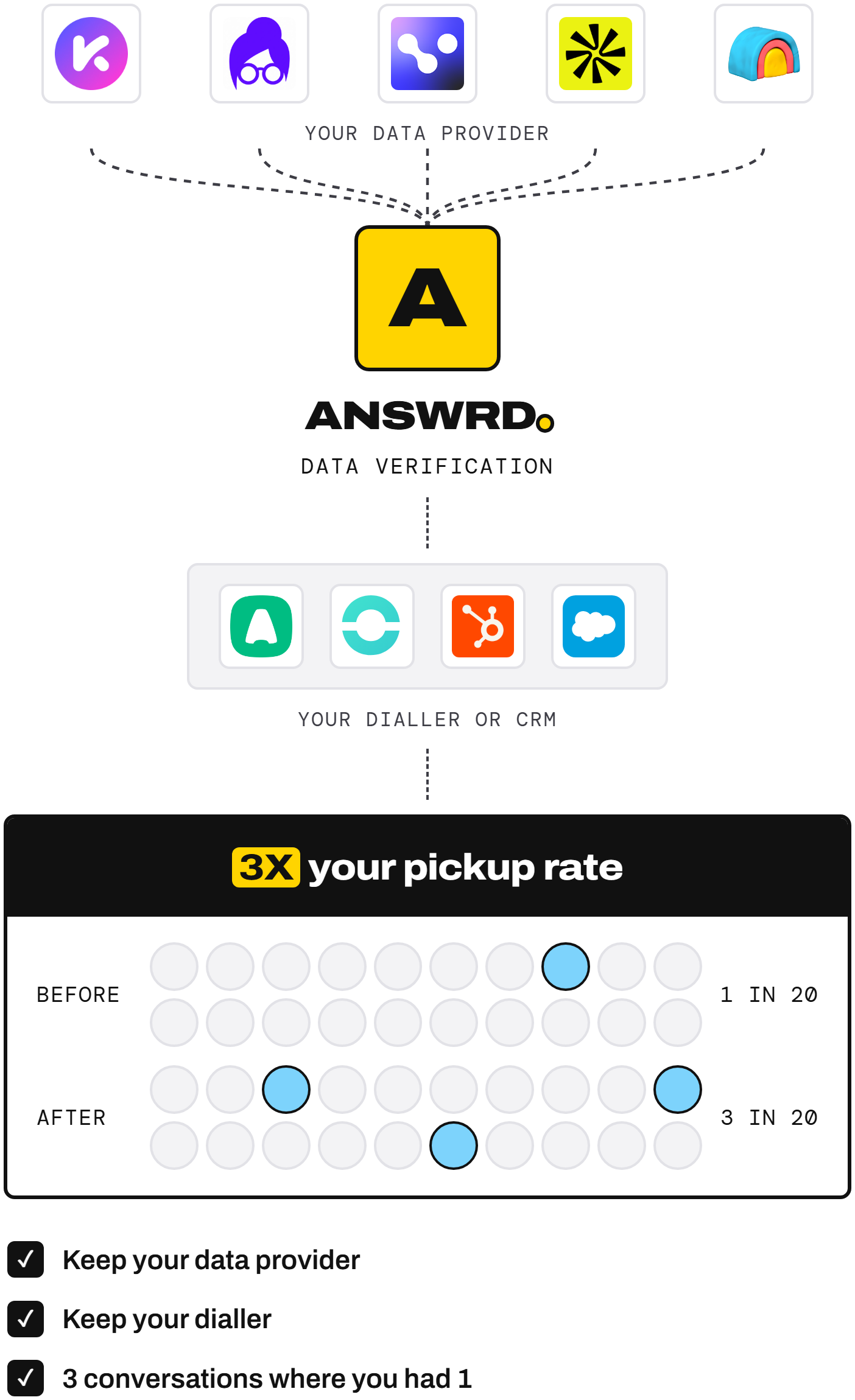
Where Answrd fits: numbers from your data provider go through Answrd verification, then into your dialer or CRM. Before, 1 in 20 calls picks up. After, 3 in 20.

Answrd is not a dialer and doesn't sell data. It works on the numbers you already have.

Questions security sales teams ask

We already pay for a data provider. Why add Answrd?

Your provider finds numbers. It doesn't tell you which ones reach the right person. Every provider has gaps, and adding a second one mostly finds the same numbers again. Answrd works on top of the one you have.

Does this work for CISOs at large enterprises?

That's where it matters most. People at large organisations are the hardest to reach by phone. Both cases above were security vendors calling security and IT leaders.

What happens to personal mobiles?

We flag them. We don't block them. Your team decides whether to call, email first, or look for a work number.

Is it GDPR friendly?

Calling fewer personal mobiles means fewer erasure requests and fewer awkward calls. We only check the numbers you send us.

How fast do I get results?

A few days for the free test.

Will it work for my country?

If you target Europe, it will work for you.

Don't believe us. Try it.

Upload 100 mobiles from your current list. We'll show you how many are dead, how many reach the wrong person and how many are private phones.

No card. Results in a few days.